

The Hidden Bottleneck Behind America’s Construction Delays
Eaton’s switchgear plant is a step toward rebuilding what COVID exposed

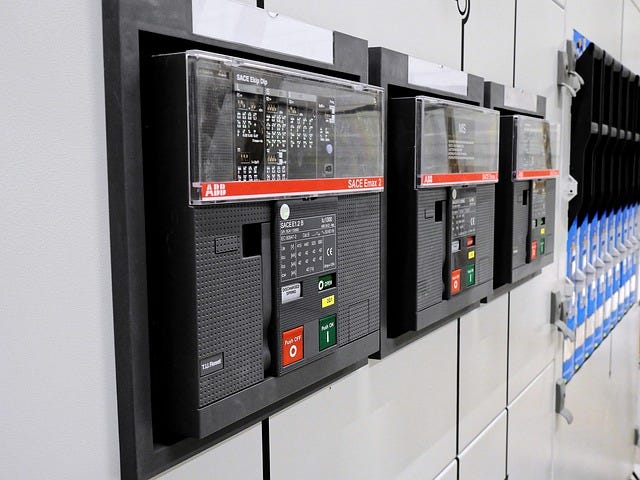
If you’ve ever renovated a home, you’ve probably been warned to expect delays. Materials arrive late. Cabinets are backordered. The tile you picked is suddenly unavailable. One missing piece can leave an otherwise finished room sitting idle for weeks or months.
Commercial construction works the same way, only on a much larger scale. A hotel, grocery store, factory, or casino may be 99% complete, but if one critical component is missing, the entire project waits. During the post-COVID construction boom, that missing component was often something most Americans had never heard of: electrical switchgear.
Think of switchgear as the building’s electrical command center. It receives power from the utility, routes it safely throughout the facility, and protects the system from faults and overloads. Until it is installed and operational, an otherwise completed building can’t receive permanent power, pass inspection, or welcome occupants.
That is exactly what happened in Oklahoma. Two new Osage Casino projects were largely complete. The marble countertops, hotel fixtures, restaurant spaces, and hundreds of slot machines were ready to go. But instead of opening as planned by the end of 2022, the casinos sat empty for nearly another year.
In the Spring of 2023 in Kansas, a new Whole Foods in Overland Park followed the same pattern. The shelves, refrigeration systems, checkout lanes, and polished grocery aisles were all ready to go—but customers wouldn’t shop there for another six months!
These were not isolated oddities. They were symptoms of a much larger supply-chain failure.
Following COVID, Americans became painfully familiar with global trade disruptions. Everything from disinfecting wipes to medicines to masks was suddenly harder to find, often because production or key inputs depended on strained overseas supply chains, especially in China. Switchgear was one of thousands of products caught in the same chaos, but for the construction industry, it became one of the most maddening bottlenecks of all.
Across the country, construction of new homes, apartment buildings, factories, restaurants, schools, stores, and public facilities were delayed by months, and sometimes by more than a year, because the electrical equipment needed to power them had not arrived. Without it, thousands of developments were framed, roofed, wired, painted, and otherwise ready, but then ultimately delayed due to an inability to electrify the buildings and pass final inspections.
The exact numbers are hard to pin down. There is no simple public dataset showing how many projects were delayed in this way, but it is clear that the entire U.S. construction industry was impacted.
There is also no readily available data on how much of the switchgear sold in the United States is truly domestic, how much is imported, or where every component inside each cabinet is made. But the pieces we can see are revealing.
Manufacturing this electrical equipment depends on materials and components that come from many China-dominated supply chains. Just a few examples: China produces roughly 57% of global refined copper, about 60% of primary aluminum, 53% of crude steel, more than half of printed circuit boards, and more than 90% of processed rare earths and rare-earth magnets. Given that reality, essentially all modern switchgear is either made in China or made with at least some Chinese-made materials or components. That is why, at the height of the post-COVID construction crisis, contractors and suppliers kept giving the same explanation for the delays: the bottleneck was in China.
Which is also why a recent announcement by Eaton, an American power management company, is so significant. Eaton is investing more than $30 million to open a 370,000-square-foot manufacturing facility in Bellevue, Nebraska, where it will produce air-insulated and gas-insulated medium-voltage switchgear for data centers, utilities, and industrial customers. The plant is expected to begin production in the first half of 2027 and add more than 200 engineering, manufacturing, and production jobs.
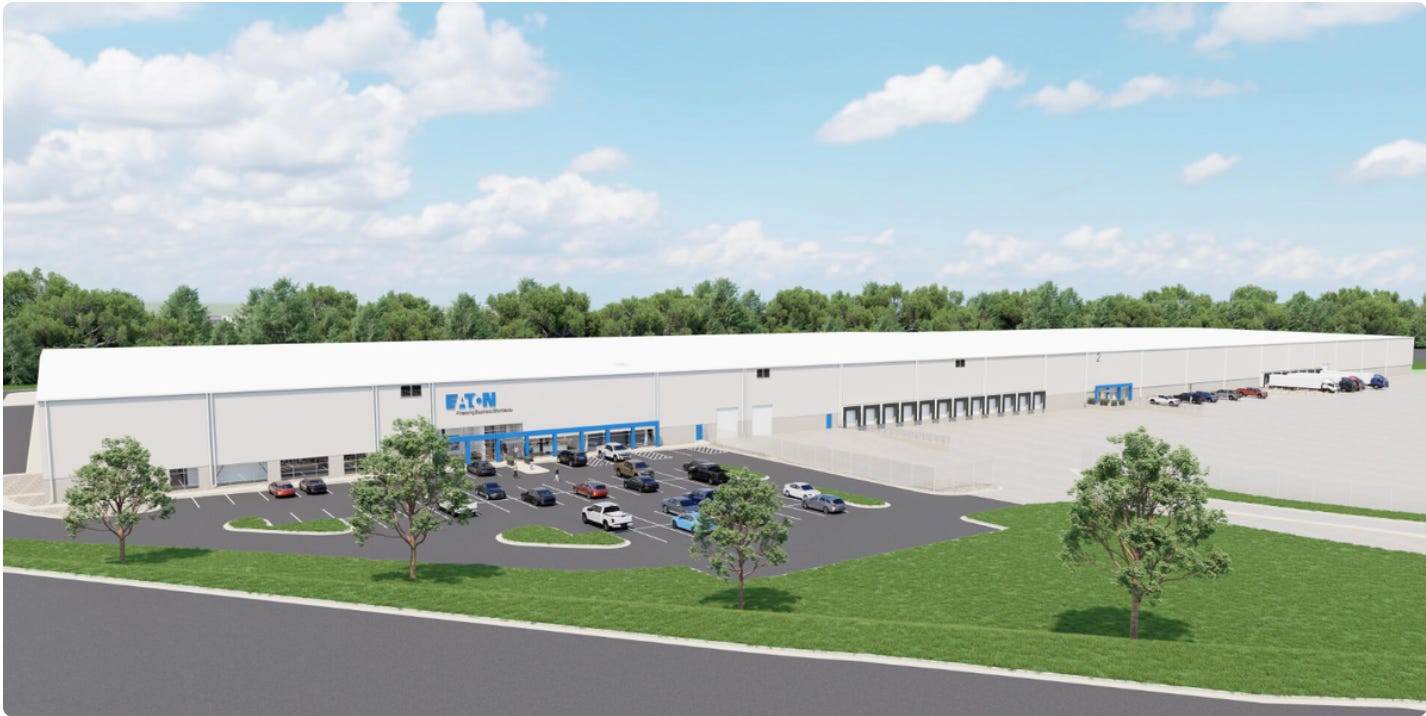
The timing matters because the switchgear problem did not disappear when the worst of the pandemic disruptions faded. Lead times are no longer as chaotic as they were a few years ago, but electrical equipment remains one of the hardest things to source in construction. Medium-voltage switchgear can still take 40 to 60 weeks or more to arrive, with transformers, breakers, generators, and other power equipment also remaining long-lead items. And as we discussed last month in our article on copper, demand is rapidly growing, because the AI boom is driving a massive buildout of data centers—warehouse-sized facilities that require not just chips and servers, but huge amounts of electrical infrastructure to power them. So Eaton is not just responding to yesterday’s emergency. It is responding to a bottleneck that still exists and will get worse without increased production.
The larger lesson underlying this growing crisis is: the COVID pandemic did not create America’s industrial vulnerability; it exposed it. As we have covered extensively in past newsletters (see examples here and here), for decades, the United States through its policy choices forced production of countless materials, components, and finished goods to move offshore, especially to China. Between 1997 and 2022, more than 70,000 manufacturing plants shut down in the United States—an average of roughly eight factories closing every single day. China moved in the opposite direction. Between 2018 and 2023 alone, it added roughly 778,000 manufacturing enterprises—an expansion of 355 per day. Over time, that shift left the U.S. dangerously reliant on China to produce many of things that Americans depend on every day.
That vulnerability would be dangerous no matter where the dependence was concentrated. But it is especially concerning because so much of it runs through China, a tyrannical regime that increasingly threatens the United States and its allies. A future supply-chain crisis does not require another pandemic. It could come from a war, a shipping disruption, a trade dispute, export controls, or a direct confrontation with Beijing. In any of those scenarios, this dependency could be used to weaken the U.S. by denying it critical materials and components, or as leverage to pressure American leaders into accepting Chinese Communist Party demands.
That is why the Eaton announcement is encouraging. A new switchgear plant in Nebraska is exactly the kind of investment America needs more of: real manufacturing capacity, skilled jobs, and less reliance on China. This one production facility will not rebuild the entire supply chain by itself. The United States still needs more domestic capacity for copper refining, rare earth processing, circuit boards, circuit breakers, and the many other industrial layers that sit behind a finished piece of electrical equipment. But Eaton’s investment is a meaningful step in the right direction—and a reminder that rebuilding American manufacturing happens one factory at a time.
Sincerely,
Guy Barnett
PureSource
As usual, this newsletter is not sponsored by Eaton. Have a look at the U.S.- and allied-made electronics and electrical products below to support PureSource, as we continue working to build a website to make it easier to find the products you love from the places you want.





This content is reader-supported. As an Amazon Associate, PureSource earns from qualifying purchases.