

America Won Independence Before It Could Defend It

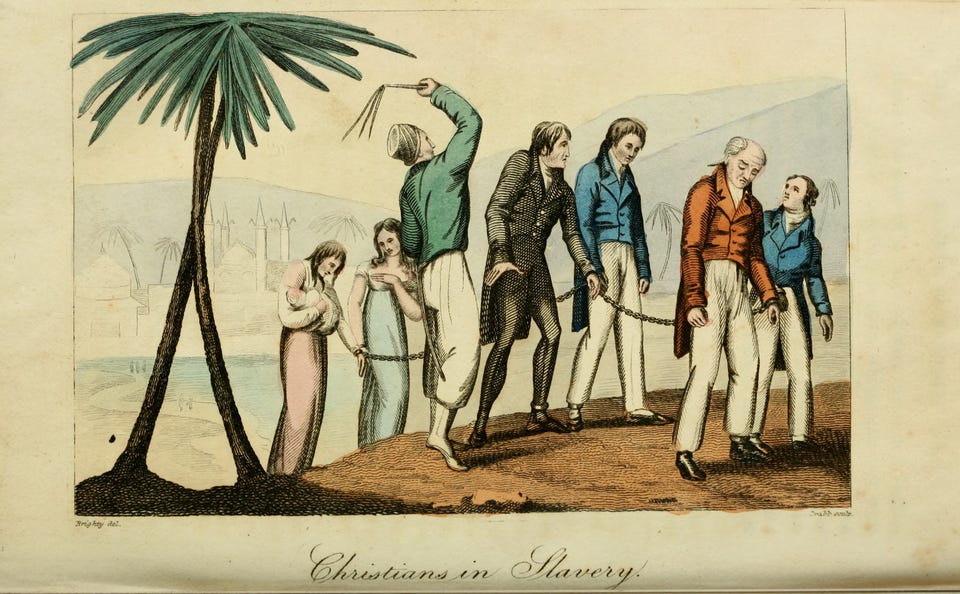
As America celebrates its 250th birthday, much of the country’s attention is naturally focused on the Revolution itself: the Declaration of Independence, the Founders, the battlefield victories, and the Constitution. But there is another part of the story worth remembering on July 4th. What happened after the Revolution? After the treaty was signed with Britain, after the guns grew quiet, were Americans finally able to enjoy the peace they had so desperately fought to win?
The answer came sooner than they might have imagined. In July 1785, just two years after the Treaty of Paris, an American schooner called the Maria was nearing the coast of Portugal after a six-week voyage from Boston. Cadiz was almost in sight when a strange Mediterranean warship began closing in. It flew no flag. Its deck looked almost empty. Then it came alongside, six brass cannon staring down at the American vessel, and armed men rose from behind the gunwales in loose garments, waving swords and knives. When they learned the crew was from the United States, they shouted with delight and began looting the ship. The Americans were taken aboard the African vessel, surrounded by a vicious mob, stripped nearly naked, and left exposed on the deck (Barnby, H. G. The Prisoners of Algiers: An Account of the Forgotten American-Algerian War, 1786–1797. London: Oxford University Press, 1966).
Their fate was slavery, and for some of them, death. A week later, another American ship, the Dauphin, suffered the same ill fate at the hands of pirates. Both crews were ultimately taken to Algiers in North Africa, along with some Portuguese fishermen who had been captured in the same way (National Archives, July 12, 2015).
To many, this may sound bizarre. But the pirates who captured the Maria and the Dauphin were part of a ruthless system that had terrorized Mediterranean shipping and European coastal towns for centuries. The Barbary pirates of North Africa seized ships, sacked seaside communities, murdered civilians, burned homes and churches, raped women, and carried off survivors into slavery—often holding them for ransom. European powers avoided the worst attacks by paying coerced “tribute”—extortion payments extracted under threat of violence, more akin to mafia protection rackets than legitimate diplomacy. American ships had been shielded before independence under the British flag, which paid these tributes. That protection vanished the moment the United States became sovereign (History Medieval, August 21, 2025).
So what could the United States do? It could not send a navy to Algiers, because the country did not yet have a fleet or the industrial base needed to support one. The United States was a new country, still overwhelmingly agrarian. It had a scattering of workshops, iron furnaces, ropewalks, gunmakers, and shipyards, but not nearly enough to supply and sustain a serious navy across the Atlantic. For all kinds of manufactured goods and specialized materials, Americans still depended heavily on Europe, especially Britain: fine fabrics, sailcloth, canvas, metal goods, tools, weapons, glassware, ceramics, and many of the inputs needed for daily life and to outfit ships and armies (Barnby, The Prisoners of Algiers. See also Alexander Hamilton, Report on Manufactures, 1791).
America won its independence before it could fully defend it. For a time, the United States had little choice but to pay tribute to the Barbary states and ransom its captured sailors. In 1801, President Thomas Jefferson refused further demands and sent American warships against Tripoli. Although the First Barbary War did not end the threat completely, it marked a turning point (Office of the Historian). During this period and the decade that followed, America changed. It did not become an industrial superpower overnight, but its population grew and its manufacturing base began to deepen. Water-powered textile mills spread from early experiments like Slater Mill. Powder works such as DuPont’s began supplying the guns and cannons of war. Water-powered sawmills, gristmills, and textile mills multiplied along rivers and mill streams, while tanneries, potteries, ironworks, and other workshops expanded the country’s local manufacturing base.
Then, after surviving another war with Britain in 1812—and for a young republic, not losing was itself a victory—America was finally ready to settle the matter in the Mediterranean. In 1815, an American squadron sailed to Algiers, fought, won, and forced a treaty declaring that no tribute, under any form or name, would ever again be required from the United States.
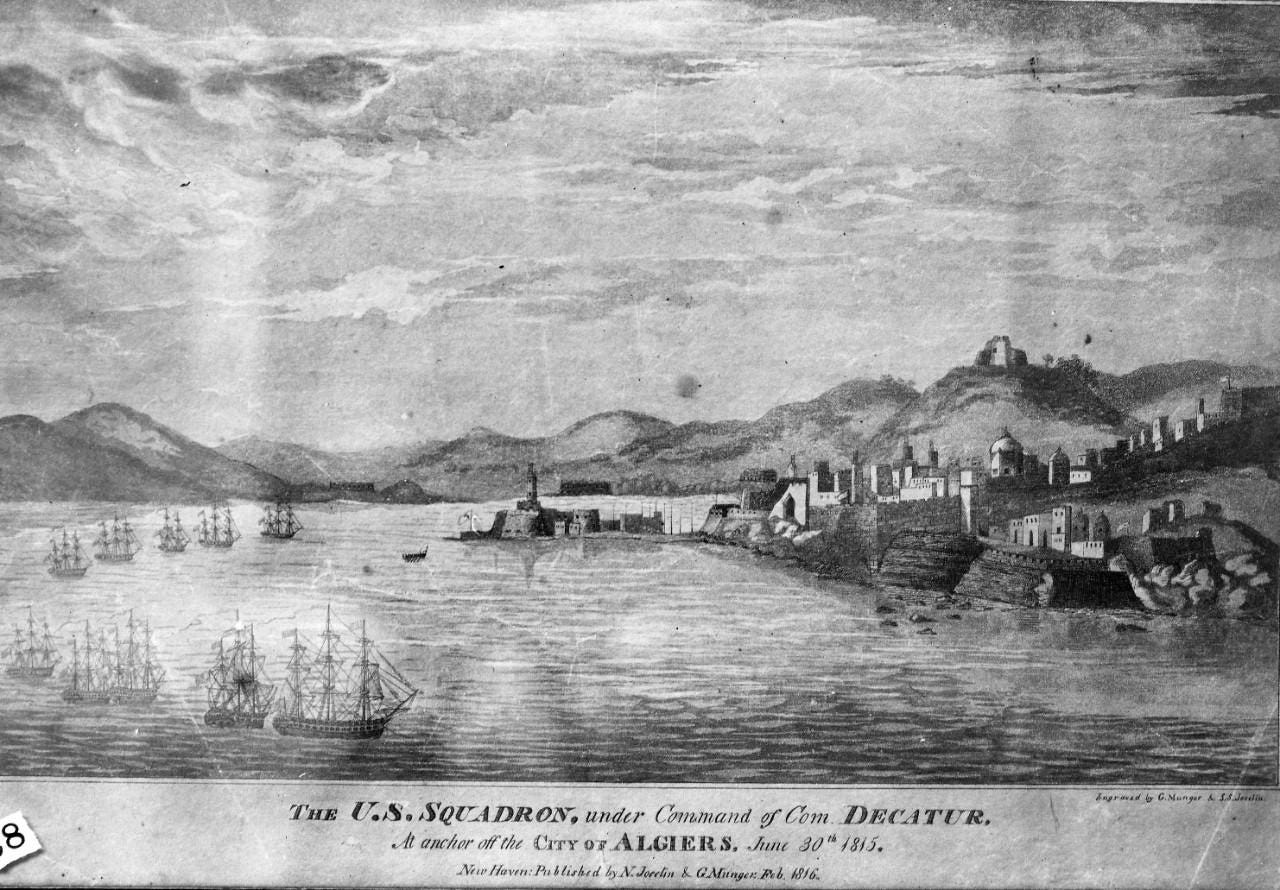
Defeating the Barbary pirates was a critical victory because it proved that American sovereignty meant something. This was not just a fight against pirates. It demonstrated to the entire world that American ships, American interests, and American citizens would be vigorously defended.
Independence is not secured by declarations, treaties, flags, or wealth alone. It depends on whether a country can build, supply, repair, and defend the things it needs when the world becomes dangerous. That was the weakness of the young United States after the Revolution; it did not yet have the ships, arsenals, workshops, and supply chains needed to defend that independence across the ocean.
The parallel to today is not exact; the United States is no longer a weak agrarian republic with no navy. It is still an extremely rich and powerful country. But beneath that wealth and power, it has created a different version of the same vulnerability. Its industrial base has been hollowed out over the last generation. Factories have closed. Skilled work has disappeared. Entire layers of production have migrated overseas, much of it to China. Once again, the question is whether America can still produce the goods, technologies, and industrial capacity on which its power ultimately depends.
At PureSource, we have been cataloguing America’s increasing dependence on China piece by piece: from light bulbs to silverware, from food production to copper, from microprocessors to solar panels. Each example may look small in isolation, but together they reveal a vulnerability that extends to virtually every product we use in our daily lives. That is not just an economic problem. It is a national security problem. A country that cannot produce what it needs cannot reliably defend itself. We saw a glimpse of this in the recent war with Iran, when the United States used scarce munitions in a few weeks that will take years to replace. Now imagine the crisis America would face if the conflict had been directly with China and lasted for months or years.
That is the same hard lesson America learned at the beginning of its history. The young republic came to see that independence on paper was not enough. It had to build the ships, workshops, arsenals, and supply chains needed to turn sovereignty into strength. Two hundred and fifty years later, the lesson is the same. The United States cannot remain free, secure, and powerful if it depends on an adversarial foreign power for virtually all of the goods, materials, components, and industrial processes Americans rely on every day. Celebrating independence should not only mean remembering what America declared in 1776. It should mean rebuilding the capacity to defend that independence, so that America can remain free, secure, prosperous, and strong for the next 250 years.
Sincerely,
Guy Barnett
PureSource
This newsletter is not sponsored. But feel free to check out the U.S.-made Independence Day collection below, which will be available on our website when it launches. As always, we’re working to find the products you love from the places you want.





This content is reader-supported. As an Amazon Associate, PureSource earns from qualifying purchases.
A cogent wake up call using our 250th anniversary to highlight our vulnerability both then and now. The parallel of the Barbary Pirates and the barbaric Iranian regime which would make the world “slaves” to their extortion of free international waterways cannot be ignored. China is watching, and sadly, this President is no Thomas Jefferson.